Loading...
Searching...
No Matches
ViewSolutions::BaseHashModel< KEY, DATA > Class Template Reference
The BaseHashModel class is the base class of all GUI hash models. More...
#include <basehashmodel.h>
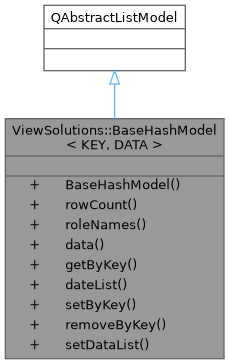
Inheritance diagram for ViewSolutions::BaseHashModel< KEY, DATA >:
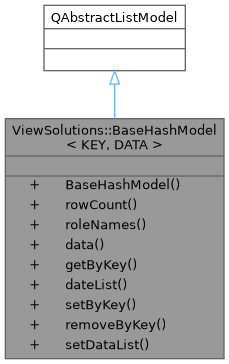
Collaboration diagram for ViewSolutions::BaseHashModel< KEY, DATA >:
Public Member Functions | |
| BaseHashModel (QObject *parent=nullptr) | |
| int | rowCount (const QModelIndex &parent) const override |
| QHash< int, QByteArray > | roleNames () const override |
| QVariant | data (const QModelIndex &index, int role) const override |
| virtual QVariant | getByKey (const KEY &key) |
| getByKey returns value by key | |
| const QHash< KEY, DATA > & | dateList () const |
| virtual void | setByKey (const KEY &key, const DATA &data) |
| setByKey update delegate by key | |
| virtual void | removeByKey (const KEY &key) |
| void | setDataList (const QHash< KEY, DATA > &newData) |
| setDataList sets new date of model, and reset all model; | |
Detailed Description
template<class KEY, class DATA>
class ViewSolutions::BaseHashModel< KEY, DATA >
class ViewSolutions::BaseHashModel< KEY, DATA >
The BaseHashModel class is the base class of all GUI hash models.
A BaseHashModel stores its items in a hash table and exposes them to QML as a list model. Every item can be accessed by a unique key.
- Template Parameters
-
KEY - is type of hash table key, DATA - is main stored delegate model of all list items.
Concepts and usage rules:
- All models should provide delegate models based on QObject
- If the model requires a fast solution, just implement a BaseListModel<T> model instead
- Note
- To access the delegate model use the Qt::EditRole role: it is available in QML by the delegateModel keyword.
- The BaseHashModel does not support the QML space directly, for short access in QML use the BaseListModel instead.
Example of a model based on the BaseHashModel:
{
Q_OBJECT
public:
IntStringModel(QObject* parent = nullptr):
ViewSolutions::BaseHashModel<int, QString>(parent) {}
};
The BaseHashModel class is the base class of all GUI hash models.
Definition basehashmodel.h:59
BaseHashModel(QObject *parent=nullptr)
Definition basehashmodel.h:62
C++ usage:
IntStringModel model;
model.setByKey(1, "first");
model.setByKey(2, "second");
QString value = model.getByKey(1).toString(); // "first"
model.removeByKey(1);
Definition at line 58 of file basehashmodel.h.
Constructor & Destructor Documentation
◆ BaseHashModel()
template<class KEY, class DATA>
|
inline |
Definition at line 62 of file basehashmodel.h.
Member Function Documentation
◆ data()
template<class KEY, class DATA>
|
inlineoverride |

◆ dateList()
template<class KEY, class DATA>
|
inline |
Definition at line 133 of file basehashmodel.h.
◆ getByKey()
template<class KEY, class DATA>
|
inlinevirtual |
getByKey returns value by key
- Parameters
-
key
- Returns
Definition at line 111 of file basehashmodel.h.
◆ removeByKey()
template<class KEY, class DATA>
|
inlinevirtual |
Definition at line 152 of file basehashmodel.h.
◆ roleNames()
template<class KEY, class DATA>
|
inlineoverride |
Definition at line 70 of file basehashmodel.h.
◆ rowCount()
template<class KEY, class DATA>
|
inlineoverride |
Definition at line 66 of file basehashmodel.h.
◆ setByKey()
template<class KEY, class DATA>
|
inlinevirtual |
setByKey update delegate by key
- Parameters
-
key data
Definition at line 142 of file basehashmodel.h.
Here is the call graph for this function:

◆ setDataList()
template<class KEY, class DATA>
|
inline |
setDataList sets new date of model, and reset all model;
- Parameters
-
newData
Definition at line 167 of file basehashmodel.h.
The documentation for this class was generated from the following file:
- ViewSolutions/src/basehashmodel.h