Loading...
Searching...
No Matches
OpenSimplex2F.c File Reference
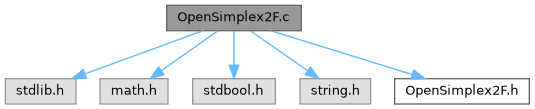
#include <stdlib.h>#include <math.h>#include <stdbool.h>#include <string.h>#include "OpenSimplex2F.h"
Include dependency graph for OpenSimplex2F.c:
Data Structures | |
| struct | Grad2 |
| struct | Grad3 |
| struct | Grad4 |
| struct | LatticePoint2D |
| struct | LatticePoint3D |
| struct | LatticePoint4D |
| struct | OpenSimplex2F_context |
Macros | |
| #define | PSIZE (2048) |
| K.jpg's OpenSimplex 2, faster variant. | |
| #define | PMASK (2047) |
| #define | B0000 0x00 |
| #define | B0001 0x01 |
| #define | B0010 0x02 |
| #define | B0011 0x03 |
| #define | B0100 0x04 |
| #define | B0101 0x05 |
| #define | B0110 0x06 |
| #define | B0111 0x07 |
| #define | B1000 0x08 |
| #define | B1001 0x09 |
| #define | B1010 0x0a |
| #define | B1011 0x0b |
| #define | B1100 0x0c |
| #define | B1101 0x0d |
| #define | B1110 0x0e |
| #define | B1111 0x0f |
| #define | ARRAYSIZE(x) |
Functions | |
| void | OpenSimplex2F_shutdown (void) |
| void | OpenSimplex2F_free (struct OpenSimplex2F_context *ctx) |
| int | OpenSimplex2F (int64_t seed, struct OpenSimplex2F_context **ctx) |
| double | OpenSimplex2F_noise2 (struct OpenSimplex2F_context *ctx, double x, double y) |
| 2D Simplex noise, standard lattice orientation. | |
| double | OpenSimplex2F_noise2_XBeforeY (struct OpenSimplex2F_context *ctx, double x, double y) |
| 2D Simplex noise, with Y pointing down the main diagonal. | |
| double | OpenSimplex2F_noise3_Classic (struct OpenSimplex2F_context *ctx, double x, double y, double z) |
| 3D Re-oriented 4-point BCC noise, classic orientation. | |
| double | OpenSimplex2F_noise3_XYBeforeZ (struct OpenSimplex2F_context *ctx, double x, double y, double z) |
| 3D Re-oriented 4-point BCC noise, with better visual isotropy in (X, Y). | |
| double | OpenSimplex2F_noise3_XZBeforeY (struct OpenSimplex2F_context *ctx, double x, double y, double z) |
| 3D Re-oriented 4-point BCC noise, with better visual isotropy in (X, Z). | |
| double | OpenSimplex2F_noise4_Classic (struct OpenSimplex2F_context *ctx, double x, double y, double z, double w) |
| 4D OpenSimplex2F noise, classic lattice orientation. | |
| double | OpenSimplex2F_noise4_XYBeforeZW (struct OpenSimplex2F_context *ctx, double x, double y, double z, double w) |
| 4D OpenSimplex2F noise, with XY and ZW forming orthogonal triangular-based planes. | |
| double | OpenSimplex2F_noise4_XZBeforeYW (struct OpenSimplex2F_context *ctx, double x, double y, double z, double w) |
| 4D OpenSimplex2F noise, with XZ and YW forming orthogonal triangular-based planes. | |
| double | OpenSimplex2F_noise4_XYZBeforeW (struct OpenSimplex2F_context *ctx, double x, double y, double z, double w) |
| 4D OpenSimplex2F noise, with XYZ oriented like noise3_Classic, and W for an extra degree of freedom. | |
Macro Definition Documentation
◆ ARRAYSIZE
| #define ARRAYSIZE | ( | x | ) |
Value:
(sizeof(x) / sizeof((x)[0]))
◆ B0000
| #define B0000 0x00 |
◆ B0001
| #define B0001 0x01 |
◆ B0010
| #define B0010 0x02 |
◆ B0011
| #define B0011 0x03 |
◆ B0100
| #define B0100 0x04 |
◆ B0101
| #define B0101 0x05 |
◆ B0110
| #define B0110 0x06 |
◆ B0111
| #define B0111 0x07 |
◆ B1000
| #define B1000 0x08 |
◆ B1001
| #define B1001 0x09 |
◆ B1010
| #define B1010 0x0a |
◆ B1011
| #define B1011 0x0b |
◆ B1100
| #define B1100 0x0c |
◆ B1101
| #define B1101 0x0d |
◆ B1110
| #define B1110 0x0e |
◆ B1111
| #define B1111 0x0f |
◆ PMASK
| #define PMASK (2047) |
◆ PSIZE
| #define PSIZE (2048) |
K.jpg's OpenSimplex 2, faster variant.
- 2D is standard simplex implemented using a lookup table.
- 3D is "Re-oriented 4-point BCC noise" which constructs a congruent BCC lattice in a much different way than usual.
- 4D constructs the lattice as a union of five copies of its reciprocal. It successively finds the closest point on each.
Multiple versions of each function are provided. See the documentation above each, for more info.
Function Documentation
◆ OpenSimplex2F()
| int OpenSimplex2F | ( | int64_t | seed, |
| struct OpenSimplex2F_context ** | ctx ) |
Here is the call graph for this function:

Here is the caller graph for this function:
◆ OpenSimplex2F_free()
| void OpenSimplex2F_free | ( | struct OpenSimplex2F_context * | ctx | ) |
Here is the call graph for this function:

Here is the caller graph for this function:

◆ OpenSimplex2F_noise2()
| double OpenSimplex2F_noise2 | ( | struct OpenSimplex2F_context * | ctx, |
| double | x, | ||
| double | y ) |
2D Simplex noise, standard lattice orientation.
Here is the call graph for this function:
Here is the caller graph for this function:
◆ OpenSimplex2F_noise2_XBeforeY()
| double OpenSimplex2F_noise2_XBeforeY | ( | struct OpenSimplex2F_context * | ctx, |
| double | x, | ||
| double | y ) |
2D Simplex noise, with Y pointing down the main diagonal.
Might be better for a 2D sandbox style game, where Y is vertical. Probably slightly less optimal for heightmaps or continent maps.
Here is the call graph for this function:
Here is the caller graph for this function:
◆ OpenSimplex2F_noise3_Classic()
| double OpenSimplex2F_noise3_Classic | ( | struct OpenSimplex2F_context * | ctx, |
| double | x, | ||
| double | y, | ||
| double | z ) |
3D Re-oriented 4-point BCC noise, classic orientation.
Proper substitute for 3D Simplex in light of Forbidden Formulae. Use noise3_XYBeforeZ or noise3_XZBeforeY instead, wherever appropriate.
Here is the call graph for this function:
Here is the caller graph for this function:
◆ OpenSimplex2F_noise3_XYBeforeZ()
| double OpenSimplex2F_noise3_XYBeforeZ | ( | struct OpenSimplex2F_context * | ctx, |
| double | x, | ||
| double | y, | ||
| double | z ) |
3D Re-oriented 4-point BCC noise, with better visual isotropy in (X, Y).
Recommended for 3D terrain and time-varied animations. The Z coordinate should always be the "different" coordinate in your use case. If Y is vertical in world coordinates, call noise3_XYBeforeZ(x, z, Y) or use noise3_XZBeforeY. If Z is vertical in world coordinates, call noise3_XYBeforeZ(x, y, Z). For a time varied animation, call noise3_XYBeforeZ(x, y, T).
Here is the call graph for this function:
Here is the caller graph for this function:
◆ OpenSimplex2F_noise3_XZBeforeY()
| double OpenSimplex2F_noise3_XZBeforeY | ( | struct OpenSimplex2F_context * | ctx, |
| double | x, | ||
| double | y, | ||
| double | z ) |
3D Re-oriented 4-point BCC noise, with better visual isotropy in (X, Z).
Recommended for 3D terrain and time-varied animations. The Y coordinate should always be the "different" coordinate in your use case. If Y is vertical in world coordinates, call noise3_XZBeforeY(x, Y, z). If Z is vertical in world coordinates, call noise3_XZBeforeY(x, Z, y) or use noise3_XYBeforeZ. For a time varied animation, call noise3_XZBeforeY(x, T, y) or use noise3_XYBeforeZ.
Here is the call graph for this function:
Here is the caller graph for this function:
◆ OpenSimplex2F_noise4_Classic()
| double OpenSimplex2F_noise4_Classic | ( | struct OpenSimplex2F_context * | ctx, |
| double | x, | ||
| double | y, | ||
| double | z, | ||
| double | w ) |
4D OpenSimplex2F noise, classic lattice orientation.
Here is the call graph for this function:
Here is the caller graph for this function:
◆ OpenSimplex2F_noise4_XYBeforeZW()
| double OpenSimplex2F_noise4_XYBeforeZW | ( | struct OpenSimplex2F_context * | ctx, |
| double | x, | ||
| double | y, | ||
| double | z, | ||
| double | w ) |
4D OpenSimplex2F noise, with XY and ZW forming orthogonal triangular-based planes.
Recommended for 3D terrain, where X and Y (or Z and W) are horizontal. Recommended for noise(x, y, sin(time), cos(time)) trick.
Here is the call graph for this function:
Here is the caller graph for this function:
◆ OpenSimplex2F_noise4_XYZBeforeW()
| double OpenSimplex2F_noise4_XYZBeforeW | ( | struct OpenSimplex2F_context * | ctx, |
| double | x, | ||
| double | y, | ||
| double | z, | ||
| double | w ) |
4D OpenSimplex2F noise, with XYZ oriented like noise3_Classic, and W for an extra degree of freedom.
W repeats eventually. Recommended for time-varied animations which texture a 3D object (W=time)
Here is the call graph for this function:
Here is the caller graph for this function:
◆ OpenSimplex2F_noise4_XZBeforeYW()
| double OpenSimplex2F_noise4_XZBeforeYW | ( | struct OpenSimplex2F_context * | ctx, |
| double | x, | ||
| double | y, | ||
| double | z, | ||
| double | w ) |
4D OpenSimplex2F noise, with XZ and YW forming orthogonal triangular-based planes.
Recommended for 3D terrain, where X and Z (or Y and W) are horizontal.
Here is the call graph for this function:
Here is the caller graph for this function:
◆ OpenSimplex2F_shutdown()
| void OpenSimplex2F_shutdown | ( | void | ) |
Here is the call graph for this function:
Here is the caller graph for this function: